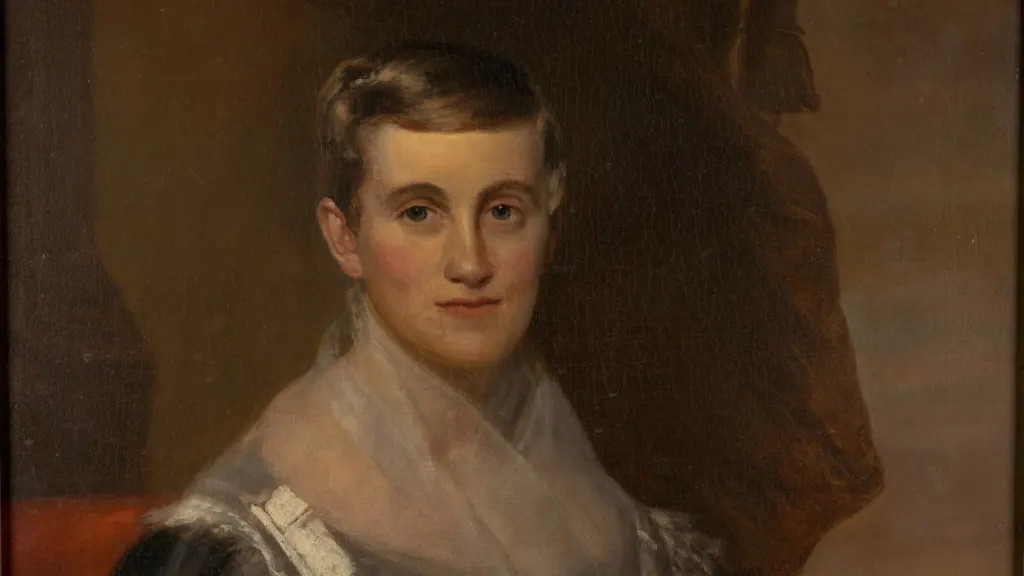
Prudence Crandall, portrait by Francis Alexander. Photo: Francis Alexander / Wikimedia Commons, public domain
Connecticut’s official state heroine was born in Rhode Island. Prudence Crandall, the teacher who opened a school for Black girls in Canterbury, Connecticut, in 1833 and was jailed for it, came into the world on Sept. 3, 1803, in Carpenter’s Mills, a village in the Washington County town of Hopkinton. Her parents, Pardon and Esther Carpenter Crandall, were Quakers.
Her family later moved west across the state line to Canterbury, and that is where her story is usually told. But it starts in South County, and the museum that now keeps it is open for guided tours on Sundays this winter.
A Rhode Island Quaker education
According to the Connecticut Women’s Hall of Fame, which inducted her in 1994, Crandall attended a boarding school in Providence before she began teaching. She taught briefly at a girls’ school in Canterbury and in 1831 bought the Canterbury Female Boarding School.
Sarah Harris and the school that followed
In 1832 a young Black woman named Sarah Harris asked to attend. The Prudence Crandall Museum, run by the State of Connecticut, says Crandall was encouraged by her conversations with Harris and with Maria Davis, a Black woman who worked for her and shared copies of William Lloyd Garrison’s abolitionist paper, The Liberator. Crandall admitted Harris. Residents protested, and white parents threatened to pull their daughters.
Rather than send Harris away, Crandall closed the school and reopened it in 1833 for Black students. The Hall of Fame notes that Garrison ran her advertisements in The Liberator. One promised a school “for the reception of young ladies and little misses of color,” at $25 a quarter. Students came from several states.
The Black Law, a night in jail and three trials
Connecticut answered by passing what became known as the “Black Law.” It barred schools from teaching Black students who were not Connecticut residents unless the town approved. Crandall was arrested, spent a night in jail and faced three trials. The first ended with no verdict. The second convicted her. On appeal, the state’s highest court threw out the case.
That did not end it in Canterbury. The museum says a nighttime mob attack in September 1834 closed the school for good. Crandall married the Rev. Calvin Philleo and moved to Illinois, where, the Hall of Fame says, she taught again from her home. Connecticut repealed the Black Law in 1838.
Many of her students, including Julia Williams, Mary Miles and Mary Harris, went on to become educators and community leaders, according to the museum. The state says Crandall v. Connecticut figured in two later U.S. Supreme Court cases, Dred Scott v. Sandford and Brown v. Board of Education.
A late apology
Decades later, with Mark Twain among those urging it, the Connecticut legislature granted Crandall a small pension in 1886. She died in Elk Falls, Kansas, on Jan. 27, 1890. In 1995 the General Assembly named her Connecticut’s state heroine.
Rhode Island’s southern towns have produced a long line of people whose names travel farther than their hometowns do, from Samuel Ward of Westerly to the marathoner Ellison “Tarzan” Brown. Crandall belongs on that list, even if the school that made her name stood across the line.
Visiting the museum this winter
The Prudence Crandall Museum occupies the Canterbury house where the school operated. It is a National Historic Landmark in northeastern Connecticut’s “Quiet Corner.” The state says it is open for two guided tours on Sundays, at 11:30 a.m. and 3 p.m., from Nov. 8, 2026, through April 18, 2027. Tours run about an hour, are capped at 15 people and cover the first-floor exhibit “Canterbury Female Boarding School: Courage, Conscience, & Continuance.” The museum is closed Friday and Saturday, and Monday through Thursday are reserved for booked private groups.
The museum will be closed on Sunday, Dec. 20, and Sunday, Feb. 14. Tickets can be bought at the door, by phone or in advance through Eventbrite, and the state strongly encourages buying ahead. A free virtual tour of the exhibit is on the museum’s website.
More South County lives are collected in our Founders section, including Princess Red Wing and the Tomaquag Museum.
Add South County Independent as a preferred source on Google (opens in a new tab)