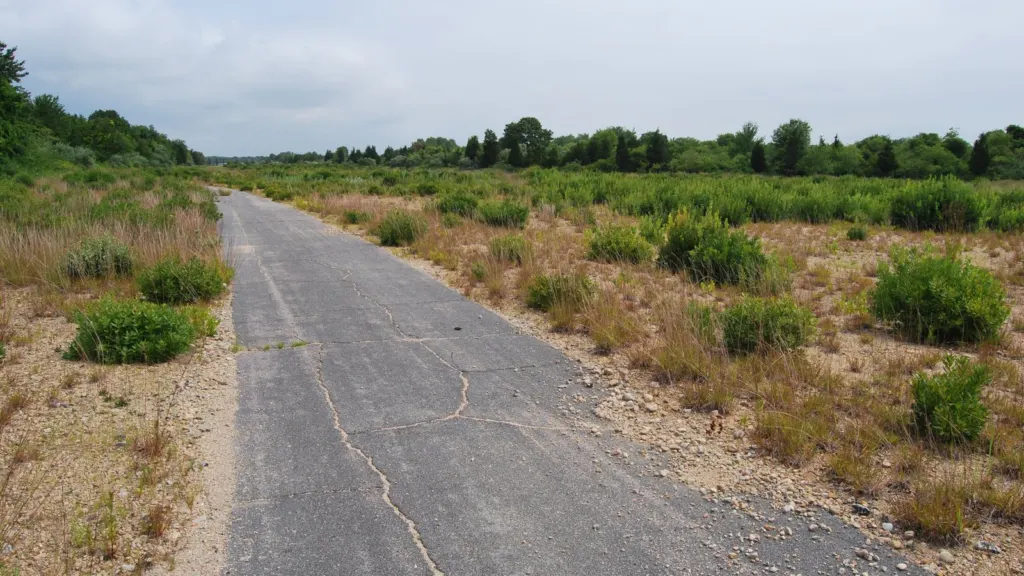
A former runway of the Charlestown Naval Auxiliary Landing Field, now part of Ninigret National Wildlife Refuge. Photo: Juliancolton, public domain, via Wikimedia Commons.
The Army Corps of Engineers has no fieldwork scheduled at Ninigret Park this week, after two weeks of tap-water sampling at nearby homes and a tank cleanout at its staging area. The pause is a good moment to look at where the long investigation into the old Navy airfield under the park stands, and what it has found so far.
The Corps posts a two-week “look ahead” schedule for the work through the Town of Charlestown. Schedule No. 68, covering Nov. 9 through Nov. 20, lists the tank cleanout and handling of investigation waste last week and “no field work scheduled” for Nov. 16 to 20. The schedule before it, No. 67, had crews collecting tap water samples from off-site homes Nov. 2 through 6.
What’s under the park
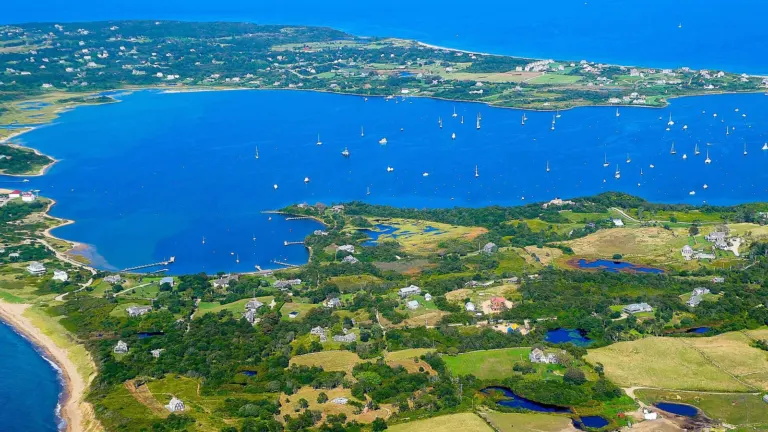
The Navy bought about 630 acres on Foster Cove and Ninigret Pond between 1940 and 1942 and turned it into the Charlestown Naval Auxiliary Landing Field, a training base for pilots and flight crews in World War II. It later supported Quonset Point and closed in the early 1970s.
The land was split in the early 1980s. About 400 acres to the south went to the U.S. Fish and Wildlife Service and became Ninigret National Wildlife Refuge, where you can still walk the old runways. The northern 230 acres went to the town and became Ninigret Park, with its ball fields, Little Nini Pond, the Frosty Drew Nature Center and the grounds for the Seafood Festival and Rhythm & Roots.
The base left a lot behind. A 2024 PFAS source investigation plan from the Rhode Island Department of Environmental Management describes three old landfills on the property. One, the 13-acre Charlestown Landfill, turned up parts from nine aircraft during digging in the 1970s. There is also a 3-to-4-acre burn pit along the south side of an old runway, where crews practiced putting out aircraft crash fires from the 1950s to the 1970s. That period overlaps with the start of firefighting foam that contains PFAS, the long-lasting chemicals that have turned up in water supplies around the country.
What sampling found
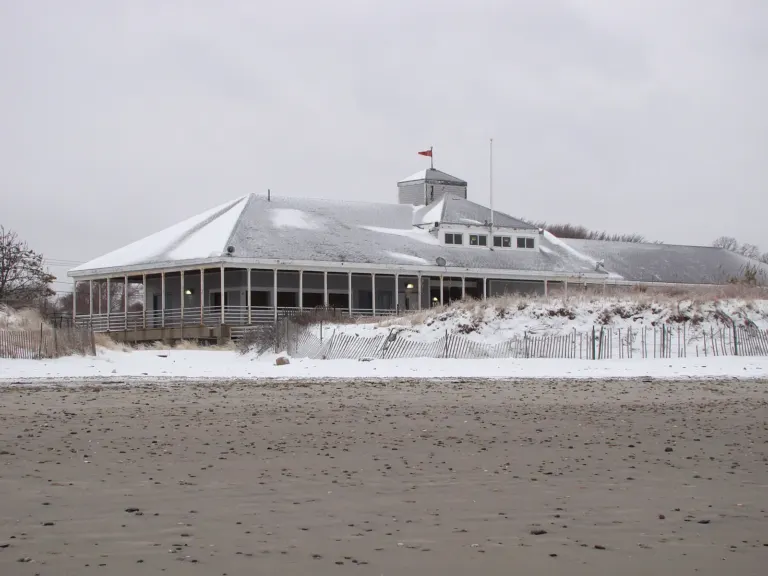
Ninigret Park runs on its own wells. The RIDEM plan lists seven: Frosty Drew, the Senior Center, the Gate House, the Beach Pavilion, the Bike Pavilion, the Seafood Festival well and the Navy well. It also counts 15 private wells east of the site boundary.
When the Corps first sampled in May 2021, two park wells came back above the federal advisory level then in place, 70 parts per trillion for PFOA and PFOS combined: the Seafood Festival well, used only for festival vendors in August, and the Beach Pavilion well, which serves the Little Nini Pond restrooms and the Rhythm & Roots festival in September. The results came too late that summer to install treatment, so the Corps posted signs in the restrooms and arranged tanker trucks of water for both festivals.
Before the 2022 season, the Corps installed treatment systems on both wells using ion exchange resin, activated carbon and ultraviolet light. It now runs and maintains them for the town and the Charlestown Chamber of Commerce.
Since then, standards have tightened. The RIDEM plan notes that Rhode Island’s interim drinking water limit is 20 parts per trillion for the sum of six PFAS compounds, much lower than the old 70 ppt advisory.
Where it goes from here
The work falls under the Defense Department’s program for formerly used defense sites, project number D01RI000809. According to the Corps’ project page, the remedial investigation samples soil, sediment, surface water and groundwater at more than 100 points to study the landfills, the burn pit, a former fire station and the water supply area. Its work plan was finalized in March 2023 and the fieldwork was planned to run into 2026.
The next big step is a Remedial Investigation Report laying out what is there and how far it has spread. That report will drive any cleanup decision. The Corps has not posted a date for it.
If you live near the park and have questions about the well sampling, the Corps contact is Gregory Hencir at the New England District, 978-318-8873 or gregory.m.hencir@usace.army.mil. The town posts each new look-ahead schedule on its news page.
Water is a running theme in South County this year, from South Kingstown’s data center ban to the management of Ninigret Pond and the breachways. More from town is in our Charlestown section.
Add South County Independent as a preferred source on Google (opens in a new tab)