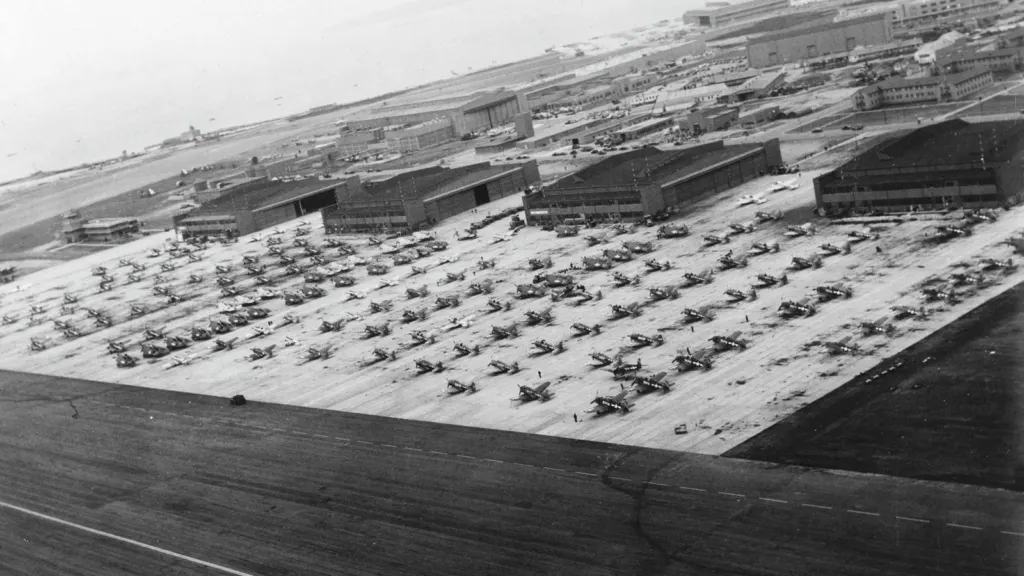
Aircraft parked at Naval Air Station Quonset Point in 1943. Photo: U.S. Navy, First Naval District, public domain, via Wikimedia Commons.
North Kingstown will mark the 85th anniversary of the attack on Pearl Harbor with a ceremony at Town Hall, a small event in a town where Dec. 7, 1941, changed almost everything.
The town’s Parades Committee is hosting a Pearl Harbor Remembrance Day ceremony at 2 p.m. in the second-floor Council Chambers at Town Hall, 80 Boston Neck Road, “to honor the lives lost on this day in 1941,” according to the town’s notice. Questions go to Town Hall at 401-294-3331.
A base that was barely five months old
When Japanese planes struck Pearl Harbor, Naval Air Station Quonset Point had been in commission for less than five months. The Navy picked the site in 1938, drawn by the shelter of Narragansett Bay and easy access to the Atlantic, according to the historical note for Providence College’s Quonset Point Naval Air Station collection. Congress approved $24,204,000 for construction on July 16, 1940, and the base was formally commissioned on July 12, 1941. Counting the Davisville construction battalion center, it covered 1,748 acres, the largest naval station in Rhode Island.
The National Park Service, which has designated North Kingstown an American World War II Heritage City, says the town’s home front story began with that construction in July 1941. Quonset quickly became the main shipping point for the Lend-Lease program and a major base for Navy planes and ships. Navy pilots trained there alongside Allied fliers, including units of Britain’s Fleet Air Arm.
What the war brought to North Kingstown
The war turned the base into something much larger. In 1942 the Navy set up the Naval Construction Battalion Center at Davisville, just north of Quonset Point, and late that year opened Camp Endicott there as the main training center for all of its construction battalions, the Seabees. Enlisted men and officers trained for six weeks before joining battalions in the U.S. and overseas, according to the Park Service.
Quonset also gave its name to a building. Engineers there produced the first Quonset hut, a light, standardized steel structure that could be made and put up quickly. The huts went to military sites around the world as barracks, hospitals, kitchens and warehouses, and many became housing after the war.
The Providence College archive notes that the base’s anti-submarine squadrons played an important part in the fight against German U-boats, that it was at the forefront of airborne radar and electronics work, and that Richard Nixon went through basic training there in 1942. By 1944, military and civilian employment at the base peaked at 162,000, a measure of how much the base came to weigh in Rhode Island’s economy.
The photo above, taken by the Navy’s First Naval District in 1943, shows the scale of it: rows of Dauntless dive bombers, Wildcat and Hellcat fighters and Avenger torpedo bombers parked in front of the hangars on the bay.
Where the history lives now
The Navy left Quonset Point in 1974, and the land is now Quonset Business Park, home to thousands of jobs, a working port and, lately, disputes with neighbors over odors. The Park Service points visitors to the Seabee Museum and Memorial Park in Davisville, where surviving Quonset huts from Camp Endicott still stand, and to the town’s remembrance ceremonies.
The Town Hall ceremony is open to the public. For more local history and events, see our North Kingstown coverage, including today’s story on the Gilbert Stuart Birthplace waterwheels.
Add South County Independent as a preferred source on Google (opens in a new tab)