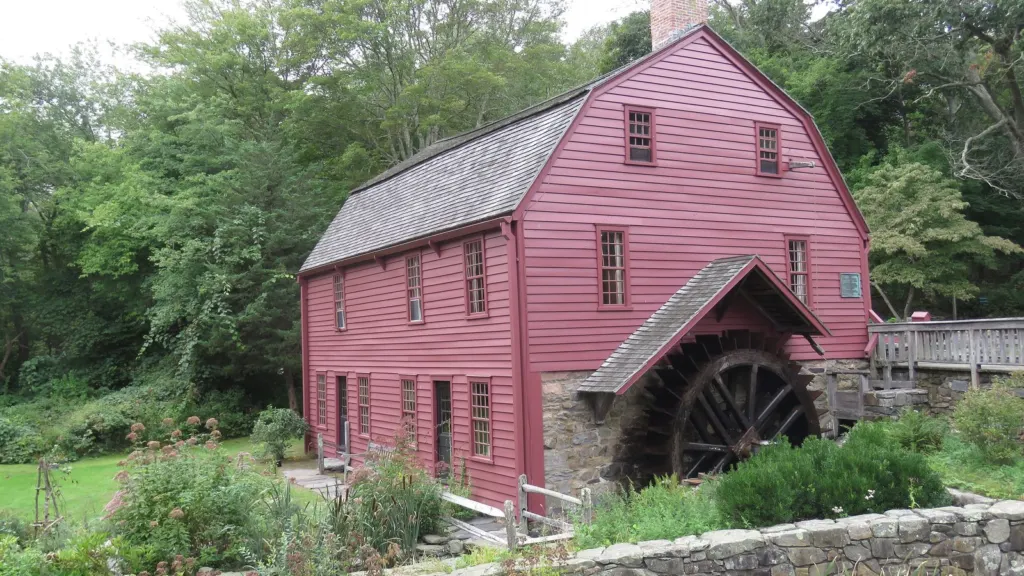
A waterwheel at the Gilbert Stuart Birthplace and Museum in Saunderstown. Photo: Astridmigu7, CC BY-SA 4.0, via Wikimedia Commons.
The two waterwheels at the Gilbert Stuart Birthplace in Saunderstown are due for a rebuild, paid for mostly by a $128,544 National Park Service grant tied to the country’s 250th anniversary.
The money comes from the Park Service’s Semiquincentennial grant program, which is spending $11.9 million on 26 preservation projects in 15 states. The North Kingstown museum’s project, listed as the Gilbert Stuart Snuff Mill and Hammond Grist Mill Waterwheel Rehabilitation, is the only Rhode Island award on the list. It is also one of the smaller ones: several of the other grants run to $700,000 or more for whole buildings.
For a site whose main attraction is machinery that still moves, the wheels are the whole point. “We are immensely fortunate, as a historic mill site, to have two such amazingly well-preserved mills. With the benefit of this grant, both wheels will be turning once again,” museum Executive Director Michelle Lee Leonard said in the museum’s announcement, as reported by the East Greenwich Pendulum.
Two mills, two histories
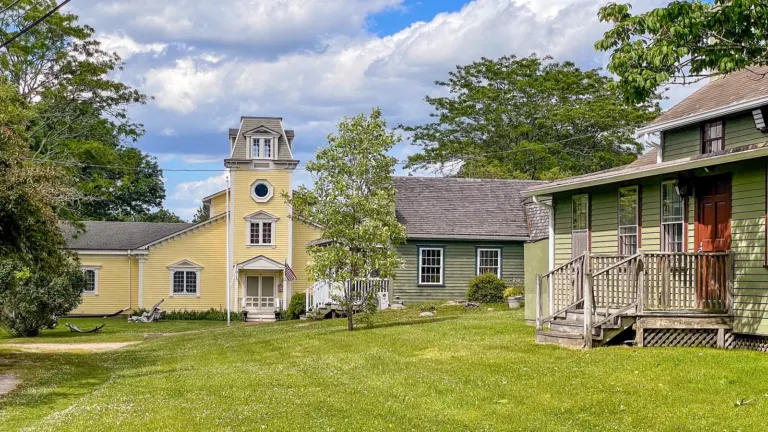
The snuff mill sits in the basement of the 1750 gambrel-roofed house where the painter was born. According to the museum, water diverted from the millpond turns a large wooden undershot wheel beneath the window of young Gilbert’s room, driving wooden gears that ground locally grown tobacco. The museum calls it the site of the first snuff mill in the New England colonies. The Stuart family ran it for 11 years, until they moved to Newport in 1761.
The Hammond Gristmill next door has its own story. Its granite millstones date to 1757, and it ground whitecap flint corn into meal for the jonnycakes Rhode Island is known for. The Hammond family, who gave the mill its name, ran it from 1813 to 1867. After a restoration finished in 2007, water powered those millstones again for the first time in almost a century, turning an 8,000-pound white oak wheel. The museum grinds corn there several times a year.
Both wheels are wood, and wood that sits in moving water does not last forever. The Park Service list describes the project simply as waterwheel rehabilitation for both mills; the work has an approved budget of $135,544 including nonfederal contributions, according to the museum’s announcement.
Not the first rescue
The birthplace has been saved before. By the late 1920s, the museum’s history says, the house was in disrepair and at risk of demolition. Local art lovers raised money and bought the buildings and grounds in 1930, and architect Norman Isham, a specialist in colonial restoration, directed the work. A new waterwheel was built to match the old one, and an authentic 18th-century snuff mill was installed where the original had stood.
That nonprofit, Gilbert Stuart Memorial Inc., is the grant recipient. The Park Service’s Historic Preservation Fund, which pays for the program, has put more than $2 billion into preservation grants since it was established in 1977, the agency says, and the semiquincentennial awards are limited to properties on the National Register of Historic Places.
The site is one of several in North Kingstown that draw visitors to its colonial past, along with the shops of Wickford Village. Readers who want the longer story of the painter himself can find it in our profile of Gilbert Stuart and his Saunderstown birthplace, and more town news is collected under North Kingstown.
The museum is closed for the season now; it is open Wednesdays through Sundays, 10 a.m. to 4 p.m., from late April through October. The next date on its calendar is a quiet one: Gilbert Stuart was born at the house on Dec. 3, 1755, and that birthday falls on Thursday, Dec. 3. The waterwheel project period runs through Sept. 30, 2029, according to the museum, with the goal of keeping both wheels turning for visitors in the seasons ahead.
Add South County Independent as a preferred source on Google (opens in a new tab)