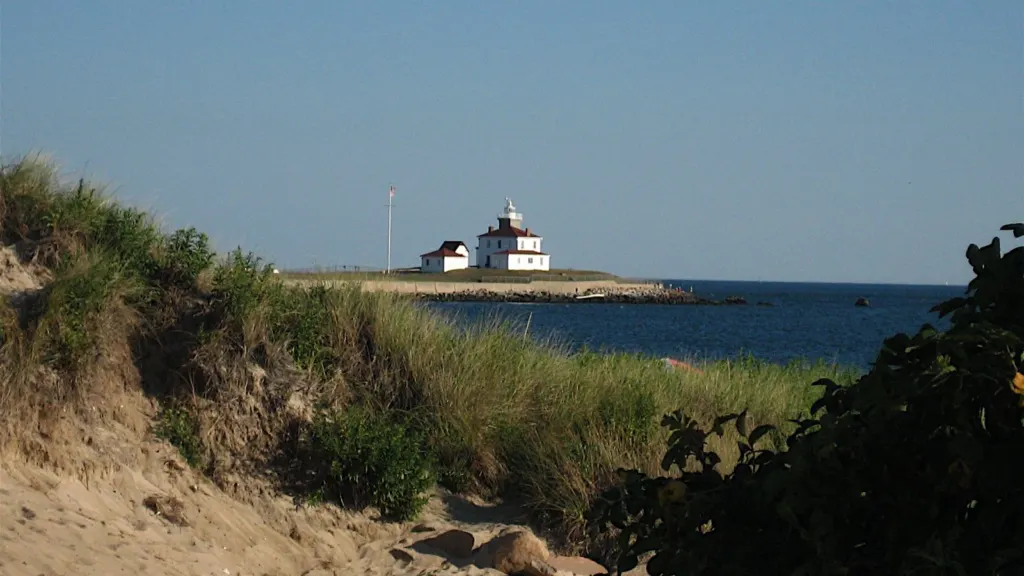
The square granite tower at the end of Lighthouse Road in Watch Hill has stood at Rhode Island’s southwestern tip since 1856. It is still a working aid to navigation, and for the past few years it has also belonged to the volunteers who spent nearly four decades looking after it.
The Watch Hill Lighthouse Keepers Association now owns the light station, according to its own history of the site. The group first took on the property in 1986, the day the light was automated, under a lease and later a license from the U.S. Coast Guard.
A watch tower before a lighthouse
Watch Hill got its name honestly. The first structure on the point, according to the association, was a beacon put up by the Colony of Rhode Island and Providence Plantations during King George’s War in the 1740s, meant to warn of naval attack rather than guide ships. A storm destroyed it in 1781.
The federal light came later. On Jan. 22, 1806, President Thomas Jefferson signed “An Act to provide for lighthouses in Long Island Sound,” which called for one on Watch Hill Point. That May, George and Thankful Foster of Westerly sold four acres at the point for $500 to William Ellery, the superintendent of lighthouses. A round, shingled wooden tower lit by 10 whale-oil lamps was finished the following year, with a one-story keeper’s house beside it.
Waves kept eating at the bluff. By the 1850s the government decided to start over, about 50 feet farther northwest.
Built from the town’s own stone
The tower built in 1855 and 1856 is gray Westerly granite: 45 feet tall and 10 feet square, made of rock-faced blocks about a foot thick and 8 or 10 feet long, laid to form corner quoins. At the same time, the shoreline in front of it was armored with granite from the Westerly quarries, the same industry we wrote about in Westerly granite, the stone that built Civil War monuments.
The association notes that building public structures of rock-faced granite was a local habit, made possible by the quarries and unusual elsewhere in New England. The keeper’s house, by contrast, was brick. The lantern on top originally held a fourth-order Fresnel lens, the French-designed glass prism system the U.S. Lighthouse Board adopted in 1852. A fog signal building with Italianate trim followed in 1909.
The light station is part of the Watch Hill Historic District, which was added to the National Register of Historic Places in September 1985.
Walking out to it in the off-season
The association’s visitor rules are simple, and they apply in November as much as July. The grounds are open from 8 a.m. to sunset all year, and the gates close at sunset. The tower and the keeper’s residence are closed to the public.
- Lighthouse Road is private. Most visitors park in Watch Hill village and walk in from Larkin Road, and the association asks people to keep quiet passing the homes along the road.
- Driving onto the property is allowed only for people over 65 or with a valid handicapped placard, with a two-hour limit, and they must stay on the property.
- Dogs must be leashed. Fires, grills, alcohol, fireworks, ball games and launching boats are not allowed, and there are no restrooms.
- The rocks around the point are slippery and dangerous, and Westerly police and private security patrol the grounds.
On a clear winter day the walk gives a view across to Fishers Island and, on the Rhode Island side, down the curve of beach toward Misquamicut. In the village, the Flying Horse Carousel is shut for the season, but the shoreline is quiet in a way it never is in August.
For more on the town, see our Westerly coverage. The association publishes its summer hours for the small museum on its website each year, and the light itself stays on every night.
Add South County Independent as a preferred source on Google (opens in a new tab)