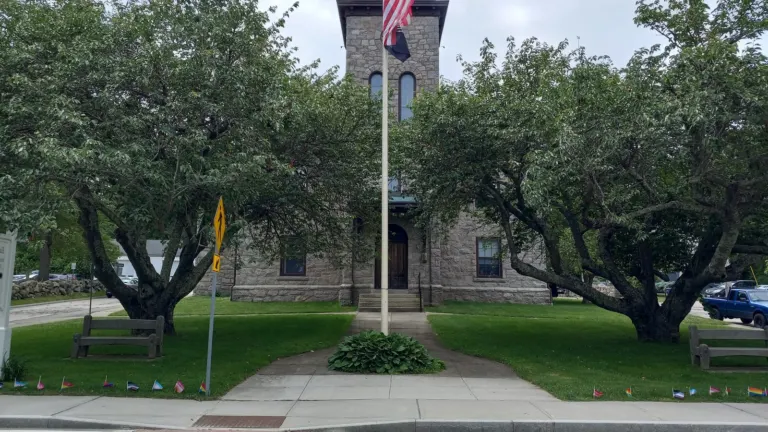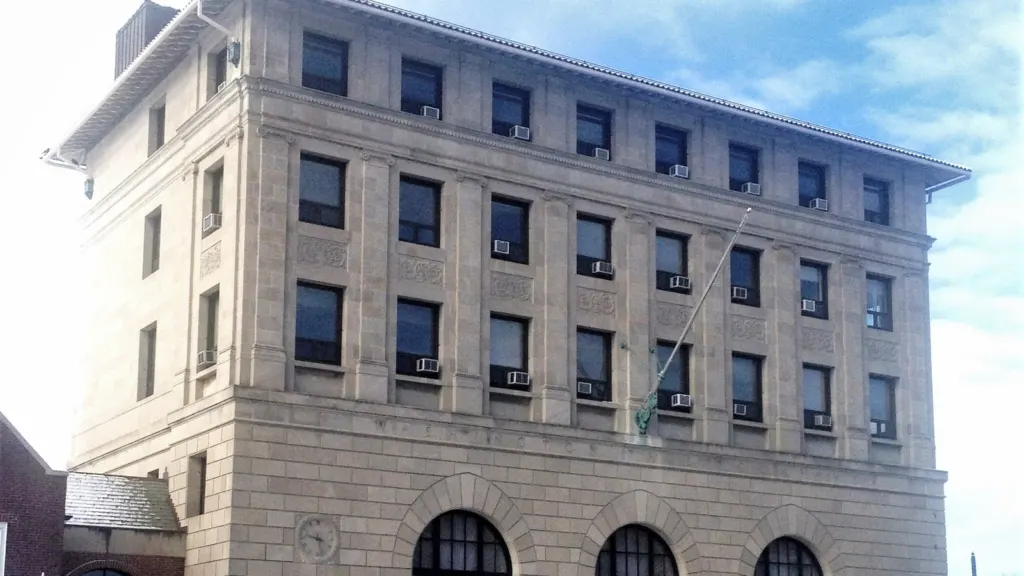
Washington Trust's headquarters building in downtown Westerly. Photo: Buckyboot at English Wikipedia / Wikimedia Commons, CC0
Washington Trust, the Westerly bank that has operated since 1800, earned $19.4 million in the third quarter, up 79% from a year earlier, as it put a troubled office loan behind it and pushed deposits to a record $5.4 billion.
The numbers come from the company’s third-quarter earnings release and its quarterly filing with the Securities and Exchange Commission. Net income was up 21% from the second quarter and up $8.5 million from the same quarter of 2025. Diluted earnings came to $1.01 a share.
For South County, the bank is more than a stock ticker. Washington Trust describes itself as the oldest community bank in the nation and the largest state-chartered bank headquartered in Rhode Island, and its headquarters is on Broad Street in downtown Westerly. How it is doing matters for local jobs and lending across the region.
The office loan that weighed on 2026
The biggest single change in the quarter was one commercial real estate loan. Washington Trust had placed a $22.3 million office loan on nonaccrual status in the first quarter, meaning it stopped counting interest it was not collecting. In the third quarter the loan was restructured and split in two: $18.5 million went back to accruing status and $3.8 million was charged off.
That one resolution did most of the work in the bank’s asset-quality figures. Nonaccrual loans fell to $24.5 million, or 0.48% of total loans, from $39.8 million, or 0.78%, at the end of June. Past-due loans dropped to $27.9 million from $41.4 million. The bank also booked $283,000 of second-quarter interest it had not recognized while the loan was on nonaccrual.
The bank’s own table of non-owner-occupied office loans shows the exposure that remains: about $208 million in total, with the largest classified balance in lab space.
Where the earnings came from
Most of the improvement came from the gap between what the bank earns on loans and securities and what it pays for deposits and borrowing. Net interest income was $44.7 million, up 15% from a year earlier, and the net interest margin widened to 2.84%, up 44 basis points over the year.
Part of that came from paying down expensive borrowing. Advances from the Federal Home Loan Bank fell to $376 million at Sept. 30, down 52% from a year earlier, as deposits grew $213 million over the same period. The bank reported no wholesale brokered deposits.
Fee businesses were mixed. Wealth management revenue was up 7% from a year earlier. Mortgage banking revenue fell 9% from the second quarter, which the bank tied to a smaller mortgage pipeline and rising interest rates. Its offices are in Rhode Island, Connecticut and Massachusetts.
Expenses rose 9% from a year earlier, led by an 11% increase in salaries and benefits for merit raises and added staff.
What it means for shareholders
The board declared a quarterly dividend of 56 cents a share, paid Oct. 9. Book value per share slipped to $27.82 from $29.02 in June, because falling market values on the bank’s available-for-sale bonds reduced shareholders’ equity on paper. Capital stayed above the “well capitalized” threshold, with a common equity tier 1 ratio of 11.93%.
Chairman and CEO Edward O. “Ned” Handy III said in the release that the bank combines “personalized service and trusted advice with the capabilities of a regional bank.”
The results sit against a tighter state picture. Rhode Island’s revenue forecast rose this month but a deficit still looms, and the state’s minimum wage rises to $17 on Jan. 1. Westerly’s other long-lived industry, granite, is in our history of the town’s quarries.
Washington Trust’s fourth-quarter and full-year report, expected in January, will show whether the margin gains held as rates moved. More on money and local economics is in our Finance section.
Add South County Independent as a preferred source on Google (opens in a new tab)