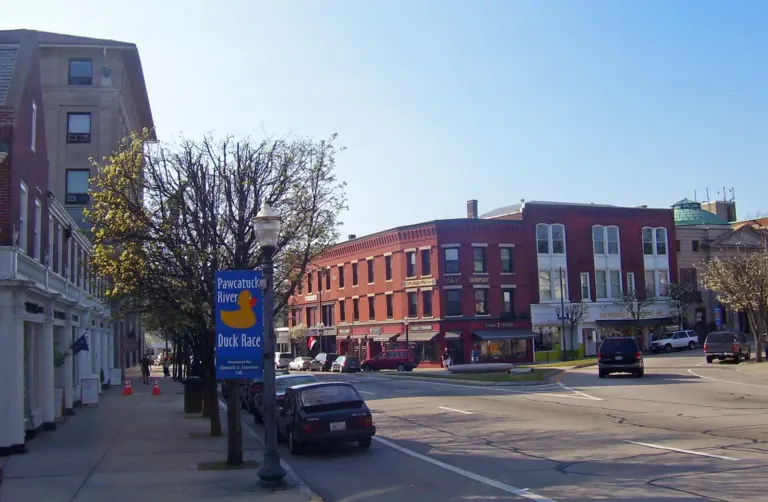
Main Street in Wakefield, South Kingstown. Photo: Kenneth C. Zirkel via Wikimedia Commons, CC BY-SA 4.0
South Kingstown Police Chief Matthew Moynihan works his last day on Nov. 4, ending a law enforcement career of more than three decades in the town where he has lived for nearly 30 years. His departure comes the day after voters decide a charter question about how much authority the next chief will have over department rules.
Moynihan announced his retirement in a statement posted to the police department’s Facebook page earlier this month. Town Manager James Manni later confirmed the Nov. 4 date, The Independent reported.
“Serving as your chief has been a tremendous honor, and I will always be grateful for the trust this community placed in me,” Moynihan wrote. “When I moved to South Kingstown 28 years ago, I knew it was a special community. What I did not know was how much the people here would come to mean to me.”
From the State Police to Block Island to Wakefield
Most of Moynihan’s career was spent with the Rhode Island State Police. Over 24 years he rose to the rank of captain and worked in investigative, intelligence and command roles, including leading the Major Crimes Unit and the Uniform Division. He also served on federal task forces.
That period also produced the HOPE Initiative, a statewide, police-led outreach program that connects people with help after an overdose. Moynihan created the program before he retired from the State Police in 2021.
He then went to Block Island, where he served as New Shoreham’s police chief and public works director. In 2022 he took the job of South Kingstown police chief and emergency management director. He has also served as treasurer of the Rhode Island Police Chiefs Association.
When he arrived, Moynihan said his priorities were community engagement, accountability and professionalism, and that he planned to meet with department staff and take stock of the department’s strengths and weaknesses.
The accreditation fight
His tenure in South Kingstown was shaped by a problem that mostly predated him. In 2024, the department lost its state accreditation after failing to meet standards covering 2020 through 2022. Most of that span came before Moynihan’s arrival, but fixing it fell to him.
The town placed Moynihan on one year’s probation. Manni said the accreditation failure was one factor, along with a no-confidence vote by the local police union. Moynihan responded publicly at the time that the department had a plan to correct the deficiencies.
In 2025, the Rhode Island Police Accreditation Commission re-accredited the department after it met 230 standards. The department is due for reassessment in three years. Moynihan credited department personnel and specifically Capt. Mark Sgalia, who led the effort.
A ballot question tied to the same issue
Accreditation also sits behind one of the local questions on the Nov. 3 ballot. Voters are being asked whether to amend the town charter so the police chief can adopt rules and regulations for department members without first getting Town Council approval.
At a Town Council meeting in mid-October, the town manager’s report addressed the question after residents said they were confused by it, according to a summary of the meeting by Uprise RI. The town has 16 standing orders that apply only to the police department, covering topics including workplace harassment, fitness for duty, promotions, light duty and use of force. Under the current charter, changing one requires public notice and two council meetings.
Town officials said the accreditation review identified the council-approval requirement as one of the major problems, and that a letter from the accreditation commission asking the town to consider the change was attached to the agenda item. Some residents have described the amendment as an overreach. A council member said at the meeting that it was more about efficiency and accreditation.
Residents who want to hear the full explanation can find it in the meeting recording on the town’s YouTube channel.
Who comes next
The town is looking inside the department for Moynihan’s successor. Under a plan still being worked out at the time of the October meeting, the new leader would become acting chief on Nov. 5 and be sworn in by the council on Nov. 9. Officials have not publicly named the candidate.
Moynihan’s own statement focused less on policy than on the people he met along the way. “Some of the best parts of this job have been the simplest ones — meeting families at community events, visiting our schools, talking with residents about their neighborhoods, supporting local organizations, and getting to know so many people throughout town,” he wrote.