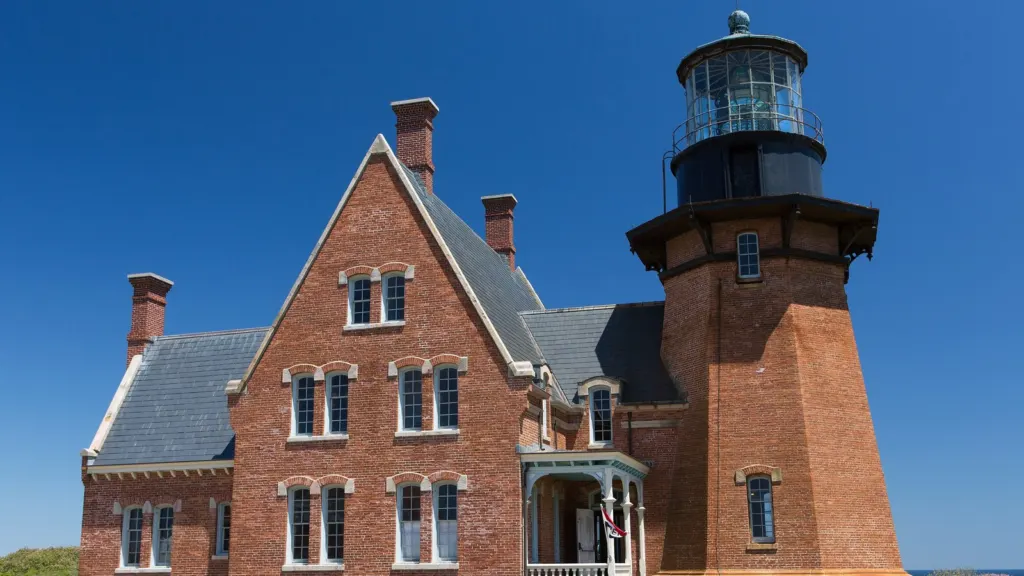
Southeast Lighthouse on Mohegan Bluffs, Block Island. Photo: Brett Weinstein / Wikimedia Commons, CC BY-SA 4.0
Visitors who walk out to the edge of Mohegan Bluffs on Block Island can find a large boulder sitting in the grass near the cliff. It marks the spot where the Southeast Lighthouse stood for 118 years, until islanders raised the money to have the whole building jacked up and rolled away from the drop.
The red brick light, first lit on Feb. 1, 1875, is now a National Historic Landmark, and the Town of New Shoreham describes it as one of the most architecturally sophisticated lighthouses built in the United States in the 19th century. The Southeast Lighthouse Foundation, which looks after it, calls it the highest lighthouse in New England.
A light for a dangerous coast
According to the foundation, a steady run of shipwrecks around the island led Nicholas Ball, a local businessman and state representative who had made his fortune in the Gold Rush, to lobby Congress for a second light. Ball had already pushed for the Government Breakwater that gave Block Island its first reliable harbor. The Southeast Light joined the island’s North Light, built in 1867.
Plans were approved in 1873, and construction was finished in 1874. The 52-foot brick and granite tower was attached to a large duplex cottage that housed three keepers and their families, the town says. It was fitted with a first-order Fresnel lens. In the late 19th and early 20th centuries, shipwreck survivors were brought to the lighthouse and sheltered there, the foundation says.
The bluff that would not stay put
Mohegan Bluffs are clay and rock, part of a glacial moraine, and they erode. The foundation notes that local farmers warned federal officials not to build so close to the island’s southern edge, because they had to move their own fences back every decade.
When it was built, the lighthouse stood more than 300 feet from the edge. The Coast Guard began measuring the erosion in the 1950s. By 1983, only about 80 feet were left, and the Coast Guard had begun weighing what it would cost to tear the building down.
The move
The Block Island Historical Society started a campaign to save the light in 1983, and the Southeast Lighthouse Foundation was set up in 1986 to run it. The effort took a decade, $2 million, three acts of Congress and the cooperation of local, state and federal agencies, according to the foundation.
In 1993, contractors braced the building with steel beams and cables, lifted it off its foundation with hydraulic jacks and set it on steel rails. The town says the move began on Aug. 13, 1993, and took 19 days. The building, estimated at 2,000 tons, was pushed about 245 feet inland, and no hurricane threatened while the work was under way. Movers then rolled a boulder to the old site.
The light had been dark for four years while plans were made. It was relit on Aug. 27, 1994. The original lens floated on a bed of mercury and could not be reused, so the Coast Guard supplied a historic French lens from a deactivated lighthouse in Virginia, according to an account published by the foundation.
Visiting
The lighthouse is at 122 Mohegan Trail. The foundation lists summer hours of 10 a.m. to 4 p.m. daily and weekend hours in spring and fall; it is closed in winter. The grounds, with views of the bluffs and the Block Island Wind Farm, are open daily from sunrise to sunset.
Planning a trip? See our guide to Block Island ferry options and the island’s trails and the people who keep them open. For how the bluffs and shoreline are being watched today, read about the island’s new flood sensors and weather stations, and for the turbines on the horizon, what the wind farm changed.
Add South County Independent as a preferred source on Google (opens in a new tab)