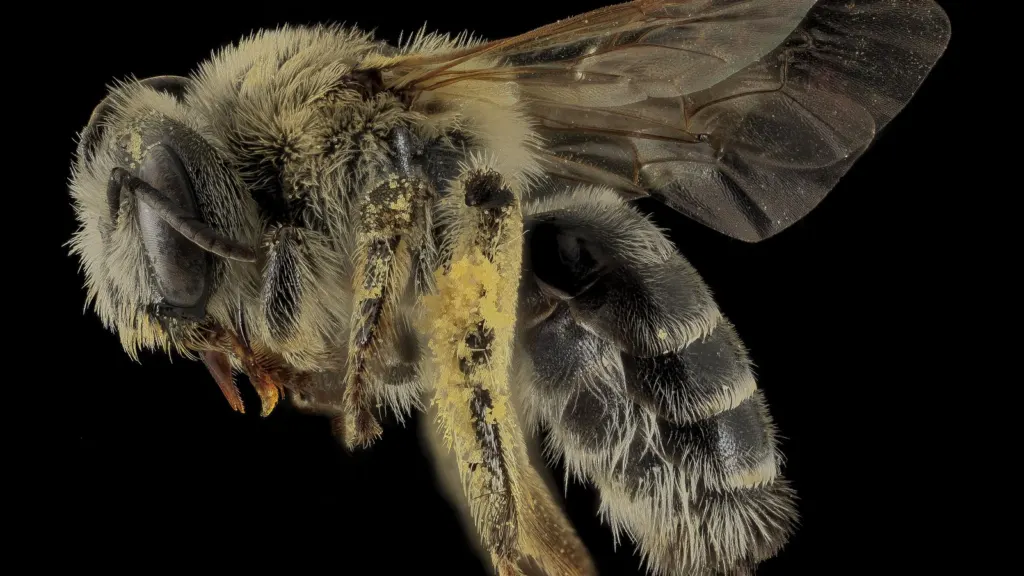
A female eastern cranberry bee (Melitta americana), a museum specimen photographed by the USGS Bee Lab. Photo: USGS Bee Inventory and Monitoring Lab from Beltsville, Maryland, USA, public domain, via Wikimedia Commons.
A two-year study of cranberry bogs in southern Rhode Island turned up a bee no one had recorded in the state before: the eastern cranberry bee, Melitta americana, a native species that feeds almost entirely on cranberry flowers.
The find comes from Ren Johnson, a doctoral candidate in the University of Rhode Island’s Department of Biological Sciences, who sampled wild bogs in South County and one commercial bog of about 100 acres. URI described the work in a Nov. 13 Q&A with Johnson, who is now finishing the paper. Some of her fieldwork was done in the Great Swamp in South Kingstown, with Abigail Gill, a 2025 URI graduate.
It is a small discovery with a practical edge for the region’s growers. Cranberries are, in Johnson’s words in the URI piece, “the most expensive crop to pollinate in the eastern United States,” because the honey bees that farmers rent by the hive cannot do the job the plant prefers.
Why honey bees fall short in a bog
Cranberry flowers release their pollen best through buzz pollination: a bee grips the anthers and vibrates its flight muscles to shake the pollen loose. Bumble bees, sweat bees and many other native species can do that. Honey bees, which came from Europe, cannot, so commercial growers make up for it with sheer numbers, saturating bogs with rented hives during the June and July bloom.
The counts from Johnson’s study show how different the wild and farmed bogs are. In the commercial bog, where hundreds of hives had been brought in, the team found mostly honey bees, along with a large number of bumble bees and smaller numbers of other natives. Across all the wild bogs, they found exactly one honey bee.
Bumble bees were the main pollinators in the wild bogs, and they and the eastern cranberry bee carried the highest share of cranberry pollen, making them, in Johnson’s words, “the most loyal pollinators.” In all, the team recorded 42 bee species visiting cranberry flowers, 35 of them something other than a honey bee or bumble bee, including sweat, mining, mason and carpenter bees.
“Knowing the most effective cranberry pollinators is essential to maximizing commercial yields, and helps explain why some wild bogs flourish while others disappear,” Evan Preisser, the URI biology professor who advises Johnson, said in the university’s release. He said the research points to native pollinators that, given suitable habitat, “could reduce growers’ reliance on imported honey bees while increasing both biodiversity and ecosystem resilience in the face of climate change.”
Rhode Island’s smaller share of the crop
Rhode Island is a minor player next to the cranberry bogs of southeastern Massachusetts, and Johnson said in the Q&A that no one seems to know the total area of wild bogs in the state. The largest single wild bog she surveyed was about 10 acres. The plants favor acidic wetlands with sandy soil, which is common across South County, but wild stands can be hard to find in enough density to sample, and a bog that is flooded one year may be reachable the next.
One encouraging result for local growers: the native bee community in the commercial bog was about as diverse as in the wild ones. Johnson credited bog owners who try to avoid pesticides when they can.
Right now, after the September-to-November harvest, the bees that will pollinate next summer’s flowers are overwintering as larvae, living on pollen and nectar their mothers left for them. They will emerge as adults in time for the bloom. Johnson’s advice for people who want to help is simple: protect wetlands and cut back on pesticides.
The work fits a pattern of volunteers and researchers paying closer attention to native plants and insects around South County, from the invasive-plant clearing at Canonchet Farm in Narragansett to the water worries behind South Kingstown’s data center ban. More of our environmental reporting is on the Coast & Water page, and the university’s wider footprint in town is covered in our look at URI in Kingston.
Johnson is preparing the pollination study for publication. URI’s College of the Environment and Life Sciences points residents to the URI Bee Lab for ways to support pollinators through the winter and into next year’s bloom.
Add South County Independent as a preferred source on Google (opens in a new tab)