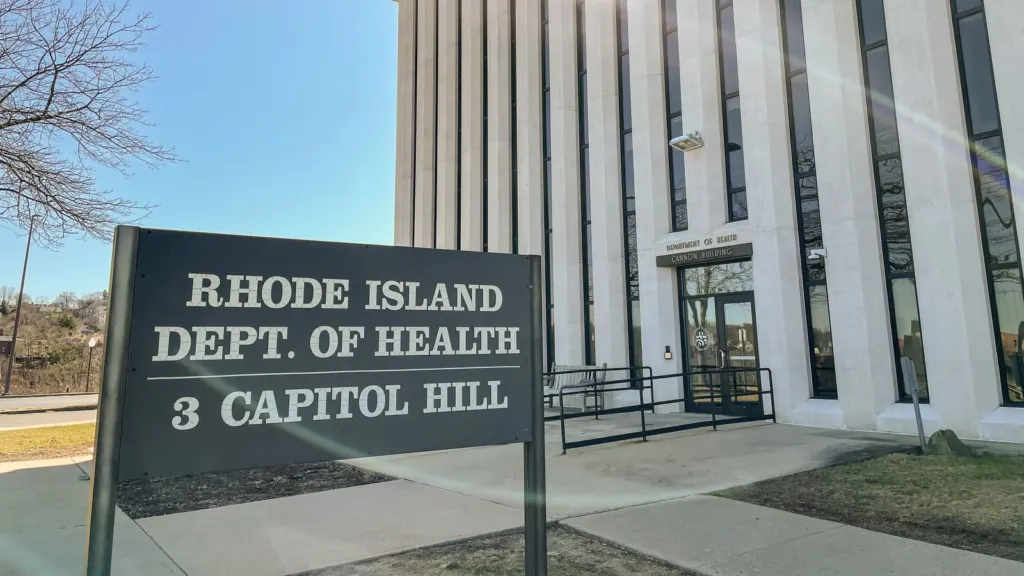
The Rhode Island Department of Health's Cannon Building at 3 Capitol Hill in Providence. Photo: Kenneth C. Zirkel, CC BY-SA 4.0, via Wikimedia Commons.
Residents of six South County towns have until Tuesday, Nov. 24, to tell the Rhode Island Department of Health what a mobile health clinic should bring to their communities.
The department’s online survey is open to adults in the state’s 18 rural towns. In Washington County that means Charlestown, Exeter, Hopkinton, Richmond, Westerly and New Shoreham, so a third of the towns the state counts as rural are in South County. South Kingstown, Narragansett and North Kingstown are not on the list.
The clinics are vans fitted with medical equipment and staffed by health workers who bring care to a town instead of asking patients to travel to it. According to the health department, the answers will help decide which services the vans offer, where and when they stop, and how they work alongside the doctors and practices already in each area. The survey is confidential, takes about 10 minutes and enters participants in a raffle for gift cards.
Where the money comes from
The vans are one piece of Rhode Island’s share of the federal Rural Health Transformation Program, a five-year, $50 billion fund created by H.R. 1, the tax and spending law signed in July 2025. The state Executive Office of Health and Human Services announced this week that the Centers for Medicare & Medicaid Services had awarded Rhode Island $158.17 million for the program’s second year, about $2 million more than the first. Total awards to the state now top $314.3 million.
About 196,000 people live in the 18 rural towns, nearly 18% of the state’s population, according to EOHHS. The office is running 13 initiatives with state agencies, hospitals, primary care and behavioral health providers, town leaders and the Narragansett Indian Tribe.
Two of those initiatives are aimed squarely at this part of the state. One, called Building Capacity for Block Island Health Services, combines care coordination, emergency medical services, aging-in-place services and food access on the island in a single investment that EOHHS says is “designed around the island’s isolation.” Another partners with the Narragansett Indian Tribe to modernize the Narragansett Indian Health Center and expand tribal public health capacity.
The mobile clinics fall under a separate initiative on community-integrated and mobile health services, which the state describes as bringing dental, nutrition and primary care to schools, community centers and neighborhoods. EOHHS spokesperson Kerri White told Rhode Island Current that $7.2 million went to mobile health programming in the first year’s budget, and that the state has not yet decided how many clinics will run or when they will start.
Who counts as rural
The list is a state definition, not a federal one. Rhode Island Current reported that the state counts towns with 25,000 or fewer residents and fewer than 1,000 people per square mile, while federal rules treat only Westerly and New Shoreham as rural. That is why Charlestown, Hopkinton and Richmond, towns many South County residents already think of as rural, qualify for the program, while denser Narragansett does not.
For residents of Hopkinton or Exeter without a car, the nearest hospital and specialist offices are a drive away in Westerly, Wakefield or Kent County. The survey asks how long it takes to reach a health appointment and how care is best delivered in the respondent’s town, the kind of answers the state says it needs before it designs routes.
Year two money will also bring four new state agencies into the program and more than a dozen new strategies focused on older residents, children and families, and veterans, EOHHS said. Ana Novais, the EOHHS assistant secretary, said in the release that “value-based and affordable care models, increased behavioral health supports, and a larger health workforce will benefit all Rhode Islanders.”
The survey link is redcap.link/rhtpmobilesurvey and it closes Nov. 24. After that, White told Rhode Island Current, a planning committee will review the responses with other assessments before it helps design the clinic program. For more on how state decisions land in these towns, see our Community and Towns coverage, including Block Island’s new flood sensors and weather stations and the quasi-public pay freeze call that reaches Westerly and Block Island.
Add South County Independent as a preferred source on Google (opens in a new tab)