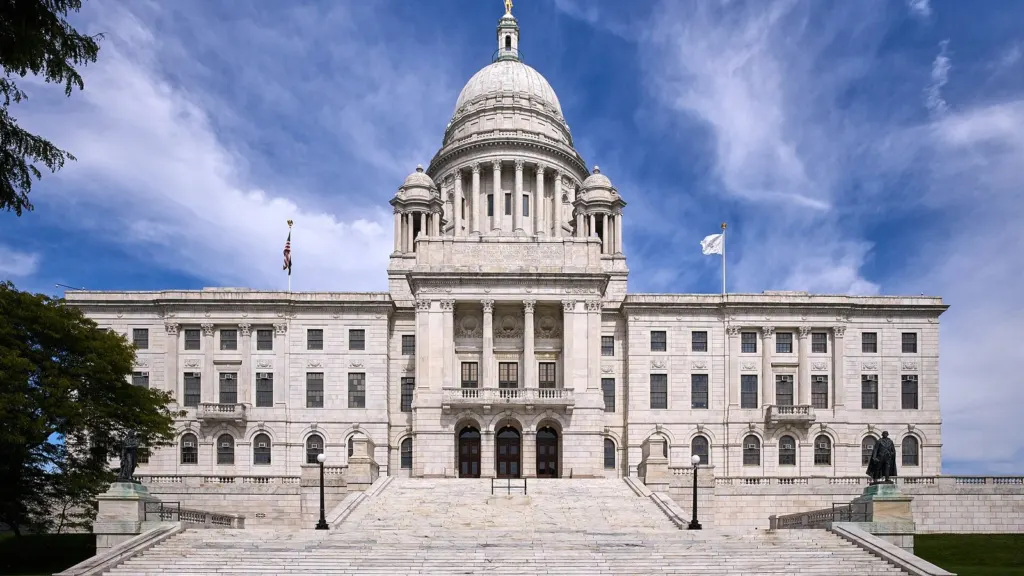
The Rhode Island State House in Providence. Photo: Frank Schulenburg, CC BY-SA 4.0, via Wikimedia Commons.
Rhode Island’s budget writers will have about $109 million more to work with this year than they planned for, but state leaders were quick to say it won’t close the gap they see coming in the next budget.
The state’s Revenue and Caseload Estimating Conference wrapped up Tuesday by raising its forecast for general revenue in the current fiscal year, which ends June 30, to $6.154 billion. That is $108.7 million above the estimate lawmakers used when they passed the fiscal 2027 budget in June, according to the adopted conference worksheets.
Where the extra money comes from
Most of the increase is in two places. The forecast for the state’s 7% sales and use tax rose by about $60.6 million, to $1.841 billion. Business corporation taxes were raised by about $49.5 million, to $432.8 million.
Not everything went up. Personal income tax, the state’s biggest single source of revenue, was trimmed by about $24.9 million to $2.148 billion, which the Rhode Island Current reported reflects lower-than-expected withholding. Lottery revenue was nudged down by $300,000, with losses from iGaming and video lottery terminals partly offset by sports betting and table games at the Lincoln and Tiverton casinos.
For fiscal 2028, the year the next budget will cover, the conference estimated general revenue of about $6.12 billion before a hospital licensing fee is added in, a little below the new figure for this year.
Why leaders aren’t celebrating
The revenue estimate covers only the income side. When the fiscal 2027 budget passed in June, the House fiscal office projected a $240 million deficit in fiscal 2028, growing to $540 million by fiscal 2031, the Current reported. State leaders also point to federal changes to Medicaid and the Supplemental Nutrition Assistance Program under H.R. 1. Medicaid makes up about a third of the state’s roughly $15 billion budget.
“We need to think about more than just one year,” Gov.-elect Helena Buonanno Foulkes said at a news conference Tuesday. She will present her first budget proposal in January and said it was too early to say how she would use the extra revenue, though she repeated her campaign focus on housing.
Senate President Valarie Lawson said the state needs to stay “measured and responsible” given federal policy changes. House Speaker Christopher Blazejewski pointed to what he called “punishing” federal choices. Outgoing Gov. Dan McKee said the numbers show he is leaving the state in better fiscal shape and set the stage for holding the line on taxes.
What it means for South County
South County towns, which run on a July 1 fiscal year, put their budgets together in the spring, after the governor’s proposal lands and while the General Assembly is still working on the state budget. Local finance officials watch that process closely because state school aid and other municipal aid are set in it. The conference’s numbers are the starting point for that debate, not the end of it.
Some new local borrowing is already in the pipeline after this month’s election, including Narragansett voters’ approval of up to $3 million for its Fire Station 3, according to election results reported by Eastern RI News.
The estimating conference will meet again in May to update the forecast before lawmakers finish the fiscal 2028 budget.
Add South County Independent as a preferred source on Google (opens in a new tab)