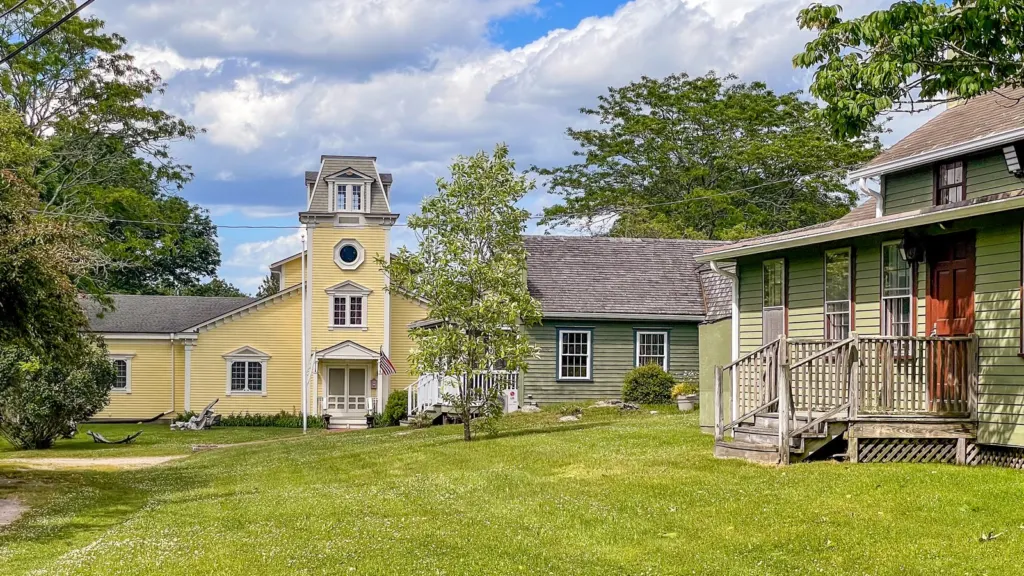
The South County Museum on the grounds of Canonchet Farm in Narragansett. Photo: ajay_suresh, CC BY 2.0, via Wikimedia Commons.
Volunteers at Canonchet Farm in Narragansett have spent more than a decade pulling invasive shrubs and vines off the town-owned land along Narrow River, and many of the plants coming back in their place are ones nobody put in the ground.
“We don’t technically grow anything here,” Tom Hoagland, president of the Friends of Canonchet Farm and a URI Master Gardener, said in a University of Rhode Island profile published Thursday. “But as we clear invasives from the property, the ecosystem responds with the growth of many native plants whose seeds exist in the seed bank but were suppressed by the invasive shrubs and vines.”
The 174-acre property off Boston Neck Road takes in forest, meadow and both salt and freshwater marsh on Pettaquamscutt Cove. It was once the estate of William Sprague, the Rhode Island governor and U.S. senator, and before that was Narragansett homeland; it takes its name from the sachem Canonchet. The town has owned it since 1974, and the South County Museum sits on the grounds.
Six thousand hours and a list of 13
Hoagland has been in URI Cooperative Extension’s Master Gardener Program since 2010 and has logged about 6,000 volunteer hours, according to URI. He and several other Canonchet volunteers have also completed Extension’s Invasive Plant Management Certification Program, which URI has run since 2008 with the Coastal Resources Management Council and the Department of Environmental Management. The full certification is what lets someone work in the coastal and riverbank buffers those agencies regulate, and one of the program’s field modules is a walkabout at Canonchet itself.
The Friends group, formed in 2007 to steward the property for the town, is focused on 13 species it considers the most damaging: Japanese knotweed, black swallowwort, porcelain-berry, garlic mustard, Japanese barberry, common reed, Asian bittersweet, multiflora rose, European privet, burning bush, autumn olive, Morrow’s honeysuckle and Japanese honeysuckle. The natives it is trying to protect include Virginia rose, skunk cabbage, highbush blueberry, black cherry, winterberry, shadbush, smooth arrowwood, white wood aster, bayberry and sweet pepperbush.
The work has come in stages. A Boy Scout troop working with the Narragansett Tree Society started on the swampy central trail in 2011, URI said. Volunteers pulled discarded asphalt from the beech grove near the beach entrance, hauled trash out of the central meadow and cleared invasives along the freshwater ponds across from the town beach. Free native trees from the Rhode Island Tree Association went into the cleared ground to keep the invasives from taking it back.
Goats, a stone wall and a Three Sisters garden
In 2022, a Rhode Island Foundation grant paid for a crew of 22 goats from Harmony Farms in Coventry to strip overgrown vines and shrubs from a section near the museum. That cleared space is now a Three Sisters garden, the corn, beans and squash planting led since 2023 by Indigenous Narragansett Master Gardeners who grow food there for tribal members and other families. Arrowhead Masonry, an Indigenous-led company, built a new stone wall around it.
The trail has drawn more walkers since the cleanup, URI said, and the URI women’s rowing team has spent a morning each fall since 2016 spreading gravel and sand on the main trail. This October was the latest.
The Friends offer walks and talks each spring and fall, and Hoagland said the group leads invasive-identification walks for its members as well as for the Rhode Island Wild Plant Society, URI’s Osher Lifelong Learning Institute and the Narragansett library. It also hands out a free booklet on common South County invasives at the end of walks and in local libraries each spring.
URI’s next invasive plant management class is scheduled for spring 2027; Cooperative Extension takes sign-ups for its mailing list at coopext@uri.edu. For more from town, see our Narragansett and Community pages, including the town’s second round of comment on flood and stormwater rules and our look at Princess Red Wing and the founding of the Tomaquag Museum.
Add South County Independent as a preferred source on Google (opens in a new tab)