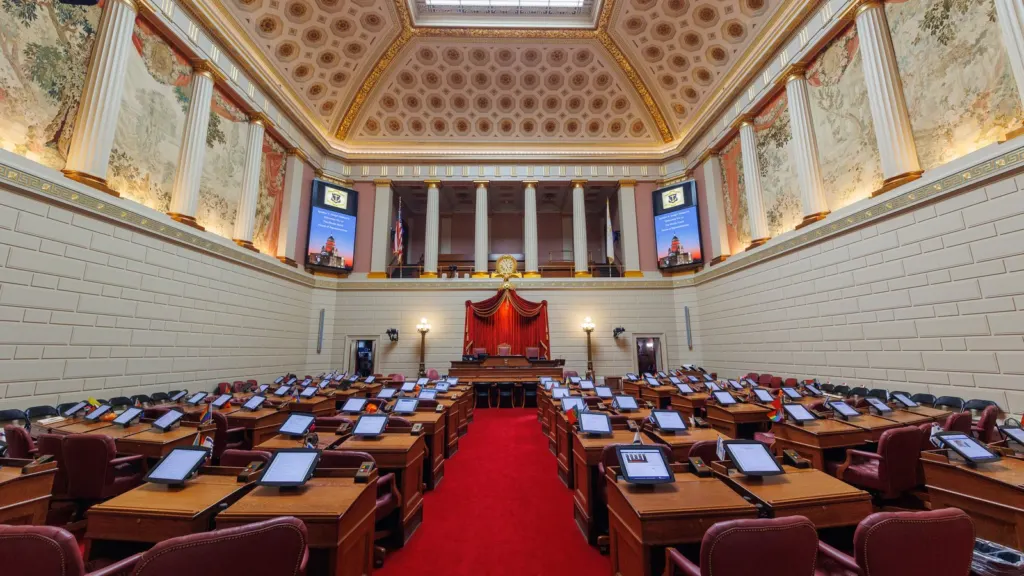
The House chamber at the Rhode Island State House in Providence, where lawmakers passed the 2025 minimum wage bill. Photo: Kenneth C. Zirkel, CC BY 4.0, via Wikimedia Commons.
Rhode Island’s minimum wage goes to $17 an hour on Jan. 1, the second and last step of the raise lawmakers passed in 2025. For South County restaurants, shops, marinas and farm stands, it is the sixth increase in six years, and it will show up in the first paychecks of 2027.
The new rate is already written into state law. Section 28-12-3 of the Rhode Island General Laws lists every step since 1999 and ends with the line that matters now: “Commencing January 1, 2027, the minimum wage is seventeen dollars ($17.00) per hour.” The state Department of Labor and Training’s minimum wage page carries the same schedule.
Gov. Dan McKee signed the bill, 2025-H 5029A and 2025-S 0125A, on Aug. 4, 2025, raising the wage from $15 to $16 this year and $17 next year. His office said at the time that about 50,000 Rhode Islanders were earning the minimum. In a statement, the House sponsor, Rep. David A. Bennett of Warwick, said the law “keeps our minimum wage rising in a predictable, stable way that allows Rhode Island’s businesses to comfortably plan for the coming increases.”
The tipped wage has not moved since 2017
The part of the law that changes least is the one South County’s restaurants and hotels watch most. Under Section 28-12-5, employers of tipped workers can pay a cash wage as low as $3.89 an hour and count tips toward the rest. That floor last rose on Jan. 1, 2017.
Because the cash wage stays put while the full minimum rises, the share an employer can cover with tips grows each year. In 2026 the maximum tip credit is $12.11 an hour, according to the Labor Department. On Jan. 1 it becomes $13.11. The rule that protects the worker does not change: cash wage plus tips must add up to at least the full minimum for every hour, $17 next year, or the employer has to make up the difference.
Taxi drivers and some small public vehicle operators are excluded from the tip credit, the statute says.
Lower rates for teens, students and seasonal resorts
A few groups can still be paid less than the full rate, and several of them are common in a beach economy.
Workers who are 14 or 15 can be paid 75% of the minimum if they work 24 hours a week or less, under Section 28-12-3.1. That is $12 an hour now and works out to $12.75 next year. In any week they go over 24 hours, they get the full wage for every hour.
Full-time students under 19 who work for a nonprofit school, religious group, library or community service organization can be paid 90% of the minimum, $14.40 this year and $15.30 in 2027.
The Labor Department also lists an exception for seasonal resorts that serve meals and open six months or less a year between May 1 and Oct. 1, and for camps with structured programs that run seven months or less and keep no year-round full-time staff. Trailer camps do not qualify. Owners who think they fit should check the statute and the department’s guidance before setting wages for next summer.
Where $17 puts Rhode Island
The minimum has more than doubled since Jan. 1, 2013, when it was $7.75. It rose to $11.50 in October 2020, then climbed a dollar or less at a time to $15 in 2025, under a 2021 law McKee signed, before the current $16.
Next year’s rate keeps Rhode Island above Massachusetts, where the minimum has been $15 since 2023, and close to Connecticut, which is at $16.94 this year and adjusts its rate each January under a state formula. Westerly businesses that hire from across the Pawcatuck River will notice that comparison first.
The raise lands on an economy that leans on seasonal hiring. Our look at what the summer season is worth to South County and the Misquamicut beach strip shows how many of those jobs are hourly, tipped or held by teenagers. Anyone opening a shop can find the state and local permits in our guide to starting a business in Washington County, and more local business coverage is in our Business section.
The $17 rate takes effect with the first shift worked on Jan. 1, a Friday. The Labor Department keeps its required workplace posters online, and workers who are paid less than the rate can file a wage complaint with its Labor Standards unit in Cranston.
Add South County Independent as a preferred source on Google (opens in a new tab)